
How a forgotten gash in Kashmir’s hills links the Great Dying to the legend of a vanished lake.
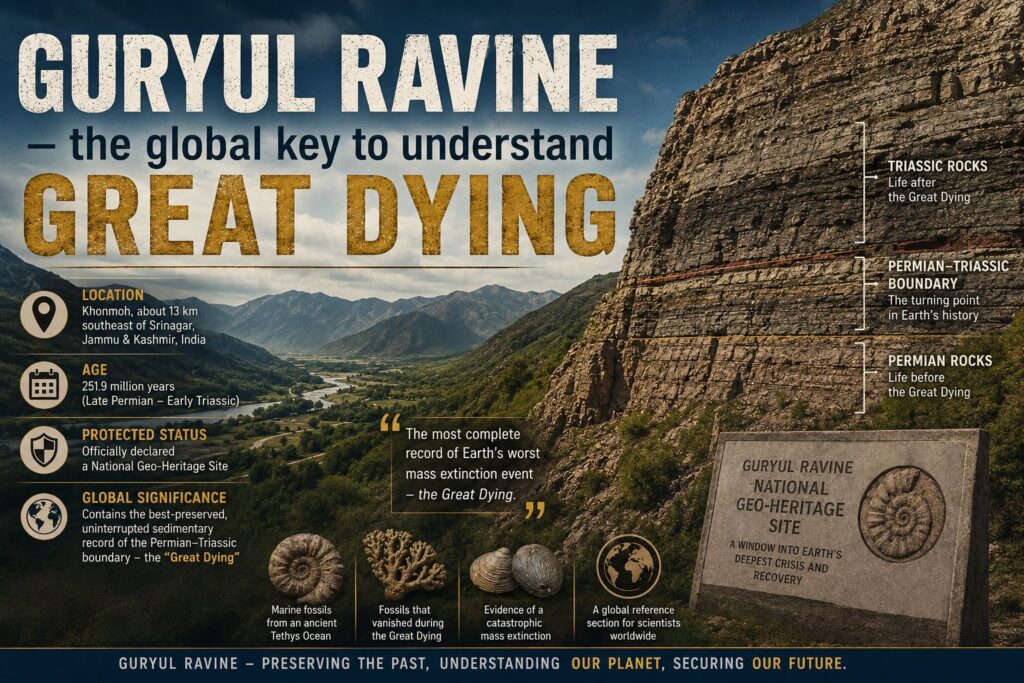
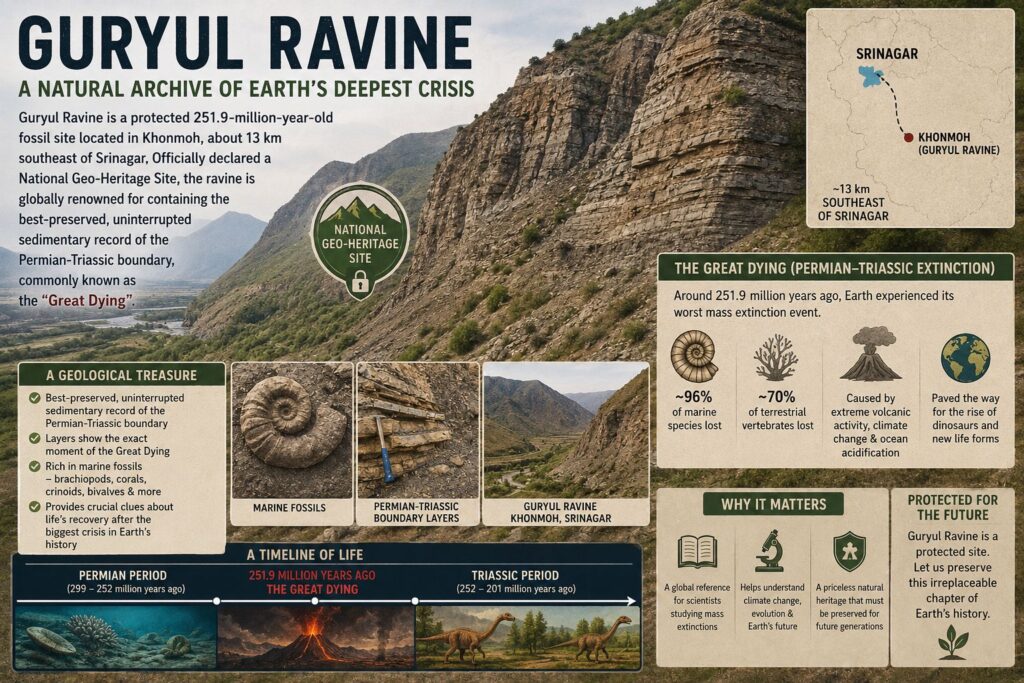
Some libraries are built of paper. Others, far older and far less forgiving of neglect, are built of stone. A few kilometres southeast of Srinagar, near the village of Khonmoh, one such library sits open to the sky ,unguarded, unglamorous, and largely unknown even to the people who live a short drive away. It is called Guryul Ravine, and within its layered rock face, the planet has preserved an account of its own near-death, written not in ink but in sediment, 252 million years before anyone existed to read it.
In December 2025, the Geological Survey of India formally designated Guryul Ravine a National Geoheritage Site. That recognition is overdue, but it understates what the ravine actually represents. This is not simply a rock formation worth a plaque. It is a rare point of convergence between deep geological time and the earliest layers of Kashmiri civilizational memory a place where hard science and ancient narrative, arriving from entirely different directions, appear to describe the same landscape transformation.
An Ocean Where the Valley Now Stands
To understand what Guryul preserves, it helps to discard the Kashmir Valley as it exists today its chinars, houseboats, and the Zabarwan hills and replace it, in the mind’s eye, with an open seabed. This was once the floor of the Tethys Sea, a warm and expansive ocean lapping against the northern edge of the ancient supercontinent Gondwana. The same tectonic collision between the Indian and Eurasian plates that eventually thrust up the Himalaya also lifted these old seafloor sediments into daylight, and it is precisely those sediments that the exposed rock at Guryul Ravine contains.
Embedded within them are the fossilized remains of brachiopods, bivalves, ammonoids, and conodonts marine organisms that lived and perished long before dinosaurs walked the earth, before flowering plants existed, before mammals had any real claim on the planet’s future. Their disappearance coincides with the Permian–Triassic extinction, often called the “Great Dying,” the most severe biological collapse in the fossil record. By most estimates, somewhere between 90 and 96 percent of marine species and nearly 70 percent of land vertebrates vanished in this single event a die-off so total and so globally synchronized that nothing else in Earth’s history compares to it in scale.
What sets Guryul apart from the handful of other sites worldwide that document this boundary in China, Italy, Iran, Pakistan, and Tibet is the unusual clarity of its record: roughly three metres of continuous boundary sequence, offering a Gondwanan-margin perspective that complements those other localities. More striking still is a claim now circulating in scientific reporting: that Guryul may contain the earliest documented tsunami deposit associated with the Permian–Triassic boundary anywhere on Earth. If that holds up under further scrutiny, this ravine does not merely record a mass extinction in the abstract. It may record the moment of its violence.
A Lake Called Satisar
This is where the geological narrative intersects, unexpectedly, with a much older story.
The Nilamata Purana, the oldest substantial literary text of Kashmiri civilization, opens with an origin story: Kashmir, it says, was once a vast lake called Satisar, home to the serpent-king Nila, until the sage Kashyapa cut through the mountains near Baramulla and drained the waters, making the land habitable. For centuries this has been read as theology and cultural memory sacred, symbolic, and largely outside the domain of empirical inquiry.
Yet modern geology, working independently and with no interest in scripture, has arrived at a structurally similar conclusion: the Kashmir Basin was indeed once occupied by a large lake, or a sequence of lakes, over an extended period. The evidence sits in plain sight across the valley floor in the form of the Karewa deposits thick, layered formations of clay, silt, and sand that are the textbook signature of long-term lacustrine, or lake-bed, deposition. These formed after Himalayan uplift sealed off an intermontane basin, which gradually filled with water and, eventually, drained. The drainage outlet is geomorphically traceable today near Baramulla the same location named in the Purana.
The responsible scientific position here threads a careful needle. Geology has no instrument capable of confirming or denying that a sage parted mountains with a trident; that is not a testable claim, and it is not the claim worth testing. The genuinely interesting question is narrower and far more answerable: did the communities who eventually settled this basin observe a real hydrological event the slow or sudden draining of a lake and encode that observation, in the only symbolic vocabulary available to them, as the story of Satisar? That is not a theological question. It is a sedimentological one.
Testing Memory With Stratigraphy
Sedimentology offers concrete tools for this kind of inquiry. Lacustrine clays record how long standing water persisted in a basin. Outlet-incision patterns can distinguish a gradual drawdown from a catastrophic one. Erosional unconformities and flood deposits mark abrupt transitions. Paleosols mark the point at which a lake floor finally became dry, exposed land. Radiocarbon and luminescence dating can place these transitions on a timeline — and if that timeline overlaps with any plausible window of early human presence in the basin, the Satisar tradition shifts categories: from myth to environmental memory, however refracted through symbolic language.
This is not an isolated or eccentric line of reasoning. Researchers elsewhere have increasingly explored the possibility that ancient oral and textual traditions encode real landscape events floods, eruptions, coastal inundations, river course changes , observed by premodern communities and passed down in narrative form. Some scholarship has applied a similar lens to the Mahabharata and the Ramayana, arguing that these epics preserve traces of shifting rivers and altered coastlines, though the rigour of such claims varies considerably and deserves scrutiny case by case. The underlying premise, however, is sound: people who lived close to the land before the age of written geology were not blind to its changes. They noticed, and they remembered, in the form their knowledge systems allowed.
A Library With No Pages
Guryul Ravine matters because it is the single site where these two timescales the 252-million-year-old Tethyan past and the comparatively recent emergence of the Satisar tradition can be examined within one continuous geological frame. It does not prove the supernatural elements of the Purana. It does something more interesting: it gives the human story a stratigraphic context against which it can be honestly tested.
And yet this site has spent years exposed to quarrying, dumping, and institutional indifference, despite repeated appeals from environmental groups for its protection. The new Geoheritage designation is a welcome first step, but a designation without fencing, monitoring, research access, and enforceable legal protection is a gesture, not a safeguard. Losing this ravine to a quarry would be the geological equivalent of burning an irreplaceable archive one with no duplicate copies anywhere on the planet.
Where Strata and Story Meet
What makes Guryul Ravine extraordinary is not that geology and ancient narrative tell identical stories , they do not, and should not be forced to. It is that two entirely independent systems of knowledge, separated by millennia of method and language, both point toward the same underlying truth: this valley was once water, and then it was not. One account calls it Satisar; the other calls it the Karewa Basin. Across a gap of 252 million years on one end and a few thousand years of memory on the other, what should startle us is not that the two records differ in their telling. It is that, at the deepest level, they agree at all , a reminder that the ground beneath a civilization is rarely silent. It is simply waiting to be read correctly.
About The Author


Scientific and technical evaluation seems to have unearthed the Gondwana connection