
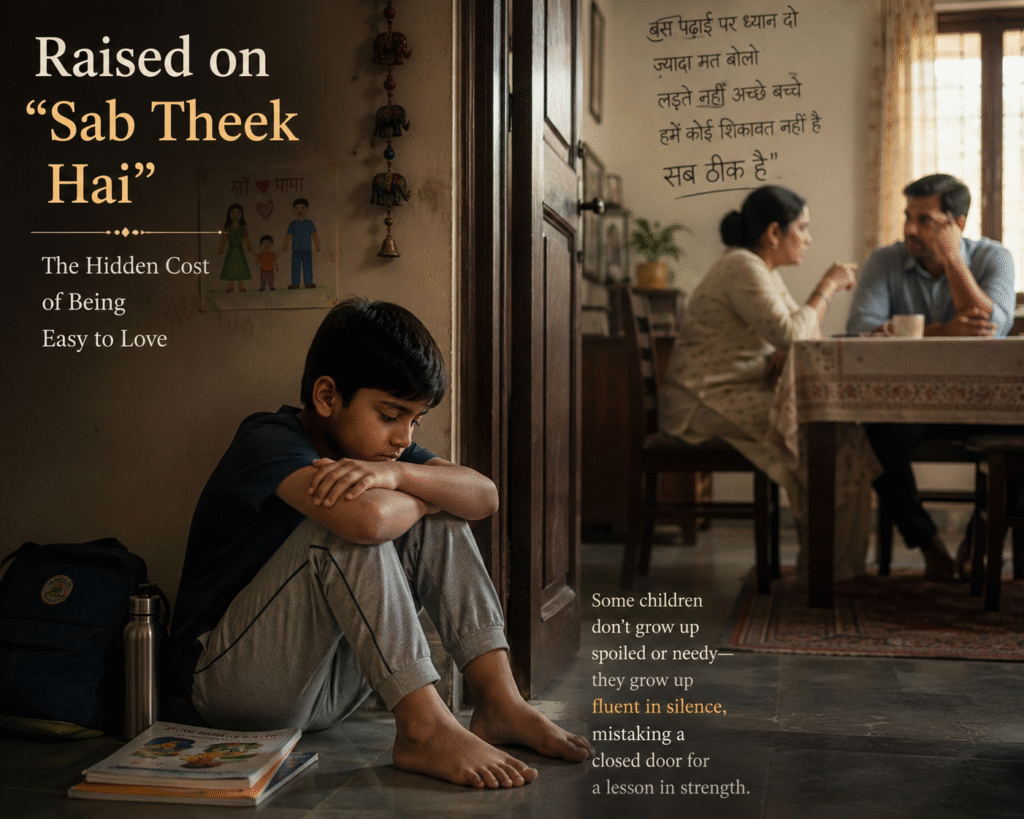
Some children don’t grow up spoiled or needy; they grow up fluent in silence, mistaking a closed door for a lesson in strength
Every Indian family has one. The cousin who never RSVPs “can someone pick me up,” the sister who drives herself to the hospital for a fracture and calls only after the cast is on, the son who tops the batch, gets the visa, sends money home every month, and never once says ma, I’m struggling. We call them the strong ones. The practical ones. The ones who “don’t create tension.” Nobody stops to ask where that particular kind of strength was actually built. It wasn’t born in them. It was built, brick by brick, in homes where asking for something cost more than it was worth.
The tiffin that came late. In a house with three siblings and one earning parent, a child learns to read a mother’s face before opening their mouth. If she’s already frying four things on two burners while the doorbell rings and the landline shrieks, “Ma, I need money for the school trip” waits. It waits so often that eventually the child stops noticing the need at all , like a fan switched off mid-spin, still turning from habit, powering down. It isn’t that the mother didn’t love enough. It’s that in a house stretched thin, timing became everything, and the timing was never right.
“Sab theek hai” is the national anthem of not okay. Ask most Indians how they’re doing during a hard week, and you’ll get the same three words, delivered with a small smile that closes the topic before it opens. Saying the truth invites a lecture, a comparison to a cousin who “has it worse,” or a worried phone call to a relative three states away. So “theek hai” becomes armor. Decades later, at family weddings, they’re still saying it : composed, smiling, unreadable while everyone assumes composed means fine.
Every favour comes with a ledger. In joint families especially, help is rarely just help. A loan for tuition gets mentioned again during a property dispute a decade later. A ride to the station becomes leverage in an argument about who’s “always been there” for whom. Children raised on this arithmetic learn fast: better to skip two meals and walk than to owe someone something they’ll bring up at your own wedding reception.
Marks were love, once. For a whole generation, being “no trouble” meant a 95% report card, no boyfriend gossip reaching home, no fights, no fuss. The praise arrived dressed as pride this one, we never had to worry about and the child mistook it for love’s price tag. Grown up, they’re the one organizing everyone’s birthday, remembering everyone’s anniversary, and going quietly unnoticed on their own.
And yet like a monsoon plant that grew strong reaching sideways for a window instead of straight up for open sky , this isn’t the whole story. It’s just the shape survival took. The tragedy was never that these people learned to cope alone. It’s that somewhere between the late tiffins and the ledgers and the report cards, “no one is coming” stopped feeling like an old bruise and started feeling like simple weather just how things are.
It never was. Someone was always capable of coming. They just never got asked.
(AI-generated image)
About The Author



The article felt deeply personal. The writing vividly captured my childhood, bringing images of my younger self to mind. It is comforting to know there is finally a voice for children like that, and I’m grateful Shefali has shed light on what they are going through today.