
The Manufactured Myth That Silenced Kashmiri Pandits – Until Now
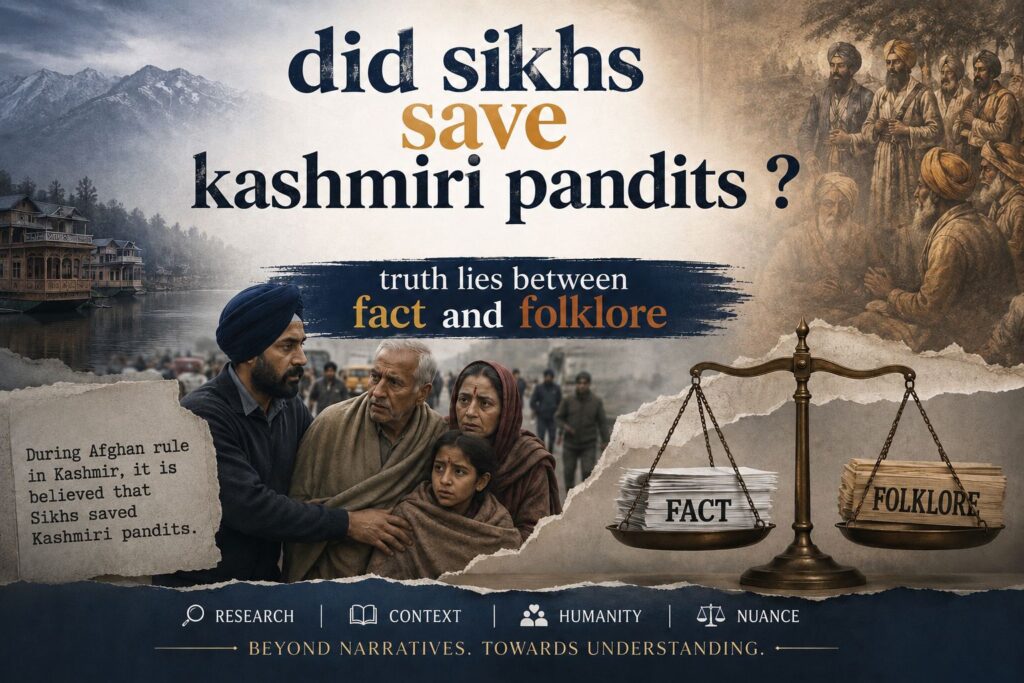
Many of us grew up hearing a particular kind of story, a Hindu community too weak to defend itself, rescued at the last moment by someone else’s sacrifice. What deserves scrutiny is the specific narrative built around it: that Kashmiri Pandits, unable to withstand Mughal atrocities, could only seek protection and wait to be saved. Repeated for generations, this story quietly hands down a burden of worthlessness and shame and that burden is a kind of curse for any community, more so for one like the Kashmiri Pandits, who carry behind them a genuinely proud intellectual and cultural past. It is worth revisiting this burdensome narrative against the historical record, to understand what actually happened.
Start with the Mughal court’s own record. The Maasir-i-Alamgiri, the standard chronicle of Aurangzeb’s reign completed in the 1680s, documents the reimposition of jizya and episodes of temple destruction elsewhere in the empire but says nothing about a Pandit deputation, nothing about a Sikh guru publicly executed in Delhi for defying a conversion order. There’s a harder problem with the Delhi setting specifically: the chronicle places Aurangzeb in the north-west, managing a Pashtun uprising, from April 1674 until the end of March 1676. He was not in Delhi in November 1675. The image of the emperor personally watching the execution doesn’t survive contact with his own itinerary.
The earliest outside account is the Padshah Buranji, an Assamese chronicle from around 1682 seven years after the event. It describes Tegh Bahadur as a politically formidable figure leading some thirty thousand armed followers, defying an imperial summons, and eventually placing himself under the protection of Raja Ram Singh. No Pandits appear in this version at all; the trouble is framed as defiance of Mughal authority, not a rescue mission.
The first Persian text to narrate the execution directly is the Siyar-ul-Mutakherin, written in 1781 over a century later. It attributes the arrest to collusion with a Sufi named Adam Hafiz in plundering Punjab and collecting unauthorized taxes, and has the Guru banished to and executed at Gwalior rather than Delhi. It quotes Political insubordination as reason.
Sikh sources from closer to the period are notably restrained on the specific point. The Bachittar Natak, attributed to Guru Gobind Singh, speaks of the Guru protecting the tilak and the sacred thread and giving his life for dharma powerful but symbolic language, with no mention of Kashmiri Pandits. More tellingly, the Zafarnama, Gobind Singh’s own letter to Aurangzeb cataloguing his grievances, doesn’t reference his father’s execution at all. If the Pandit rescue had been the defining episode it later became, this seems like the place it would surface first.
The detailed story – Brahmins traveling from Kashmir, a test of faith, a guru offering himself in their place appears clearly only in the Gurbilas Patshahi Dasvin, added in its 1848 third edition, 173 years after the death it describes. Later texts like the Prachin Panth Prakash widen the cast further, adding petitioners from Benares a sign of a legend still accumulating detail, still borrowing glory from an act that was, on its own terms, glorious enough.
Modern historians read this trajectory similarly. Audrey Truschke considers the conversion-demand story unlikely and points to political confrontation as the more probable cause. Satish Chandra notes that Kashmiri chronicles of the period, including Narayan Kaul’s 1710 history, record no campaign of forced conversion under the relevant governor.
None of this diminishes the martyrdom itself, which needs no embellishment. It does mean the specific causal story attached to it and the framing of Kashmiri Pandits as a community incapable of defending itself is an 18th- and 19th-century addition, not a 17th-century fact. The grief was real in 1675. The glory of a particular telling of it was assembled later, for later purposes. Recognizing the difference between the two is not disrespect. It’s what reading sources in order requires.
About The Author